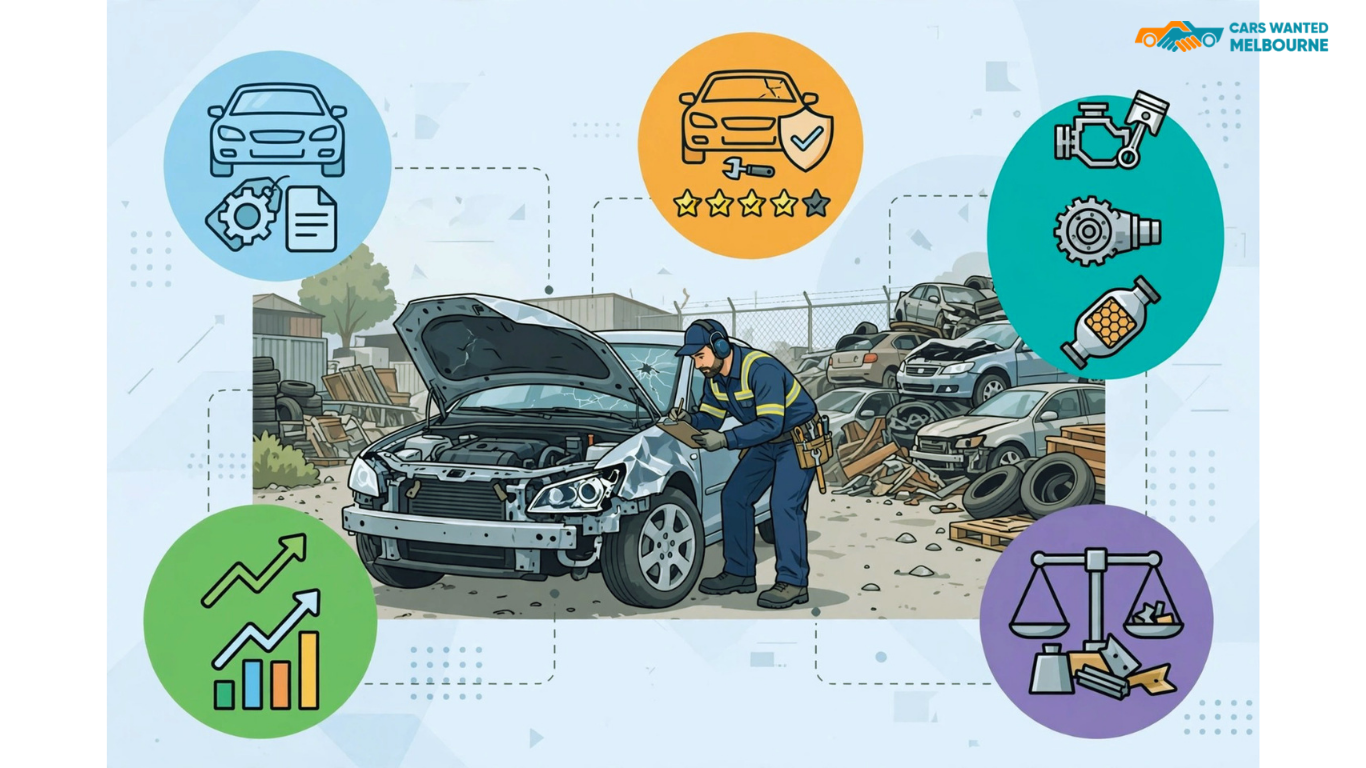
Melbourne car wreckers don’t calculate a scrap vehicle’s value from weight alone. They typically consider the vehicle’s overall weight, the amount and type of recoverable metal, reusable parts, vehicle condition, current recycling-market conditions, towing and processing costs, and demand for specific components.
In simple terms:
Estimated salvage value = recoverable metal value + reusable parts value − recovery, transport and processing costs.
The actual offer can therefore be different from simply multiplying the vehicle’s kerb weight by a scrap-metal rate.
For vehicle owners in Melbourne, this distinction matters because a complete SUV with a working engine, gearbox, catalytic converter and usable wheels can have substantially different salvage potential from a stripped or severely damaged vehicle of similar weight.
The first step is establishing an approximate vehicle weight.
A wrecker may use manufacturer specifications, the vehicle’s identification details and information about its condition to estimate its weight. In some recycling operations, vehicles or batches of scrap may also be weighed using commercial scales.
However, the number listed as the vehicle’s kerb weight should not automatically be treated as the exact amount of metal that will be recycled.
Kerb weight generally refers to the weight of a vehicle in its standard operating condition, excluding passengers and luggage.
It can include items such as:
This is useful as a starting point, but it isn’t the same thing as the amount of recoverable scrap metal.
No.
A vehicle may weigh 1,400 kg, for example, but not all 1,400 kg consists of recyclable steel.
The vehicle may contain:
A recycler therefore needs to consider the composition and condition of the vehicle rather than assuming every kilogram has the same scrap value.
Scrap weight refers primarily to the material that can be recovered and recycled, while salvage value includes the potential value of reusable components.
This distinction is important.
Imagine two Melbourne vehicles that both weigh approximately 1,400 kg.
Vehicle A
Vehicle B
Even though the vehicles originally had similar weights, they may produce very different offers.
Vehicle A could have value from both recyclable materials and reusable parts, while Vehicle B may be valued more heavily on its remaining scrap material.
A professional Car Wreckers Melbourne service generally looks at several value components rather than relying on one number.
Metal prices can change over time.
Steel, aluminium and copper do not necessarily have the same value per kilogram, and market conditions can affect what recyclers can recover when materials are processed.
This means the same vehicle may receive different valuations at different times.
The more suitable recyclable material a vehicle contains, the greater its potential scrap contribution.
Large vehicles such as SUVs, utes and vans may contain more material than small hatchbacks, but size alone doesn’t determine the final offer.
Parts can sometimes be worth more than their scrap-metal content.
Depending on the make, model, age and condition, a wrecker may assess:
Victorian guidance confirms that auto wreckers and recyclers may deal with vehicle components including panels, wheels, engine parts, windscreens, mirrors and dashboards.
A catalytic converter can affect a vehicle’s salvage value because of the valuable materials contained within its catalyst.
However, its value isn’t a fixed amount. It can vary according to the particular component, condition and recycling market.
If the catalytic converter has already been removed, the valuation may be different.
Condition can significantly influence the valuation.
A vehicle that doesn’t run isn’t necessarily worthless.
A non-running car may still contain:
This is one reason professional wreckers assess the vehicle as a complete salvage proposition rather than simply asking whether the engine starts.
Demand for replacement parts also matters.
A common vehicle with strong demand for used components may have greater parts-recovery potential than a less common model.
This means two vehicles with similar weights can still attract different offers.
The final offer also needs to account for the cost of collecting, transporting, dismantling, depolluting, storing and processing the vehicle.
For example, a vehicle located conveniently in metropolitan Melbourne may have different logistics costs from a vehicle requiring a longer recovery trip.
No.
Weight is important, but it isn’t the only factor.
Consider these simplified examples:
| Vehicle | Approx. condition | Potential value drivers |
| Small hatchback | Complete | Scrap metal + reusable parts |
| Medium sedan | Complete but non-running | Metal + parts |
| SUV | Complete | Higher material volume + parts |
| Stripped SUV | Missing major components | Reduced parts value |
| Damaged luxury vehicle | Heavy damage | Metal + selected components |
The heavier SUV isn’t automatically the highest-value vehicle.
A smaller vehicle with a desirable engine, gearbox and complete components could potentially have stronger salvage value than a heavier vehicle that has already been stripped.
Yes.
If an engine is suitable for reuse or parts recovery, it can contribute to the vehicle’s value beyond its scrap-metal content.
The actual value depends on:
Yes.
A usable automatic or manual transmission may have a resale or parts value that exceeds its value simply as metal.
They can.
Alloy wheels, steel wheels and tyres may contribute to the overall valuation depending on their condition and whether they are suitable for resale or recycling.
Potentially.
Doors, bonnets, guards, boot lids and other panels can be useful to repairers and owners looking for replacement parts.
A vehicle with straight, undamaged panels may therefore have additional salvage potential.
A car doesn’t necessarily need to be roadworthy or running to have salvage value.
Wreckers can assess:
For severely damaged vehicles, the calculation can shift towards recyclable materials and recoverable components.
For vehicles with limited damage, more usable components may remain.
Victorian regulations specifically recognise the role of auto wreckers and recyclers in dealing with incomplete, damaged and end-of-life vehicles.
It’s normal for two businesses to produce different valuations.
The reasons can include:
For example, one recycler may have strong demand for parts from a particular Toyota, Mazda, Ford or Holden model, while another may primarily value the same vehicle for its metal.
That’s why comparing offers based solely on advertised “per tonne” rates can be misleading.
You can use a simplified calculation to understand what a wrecker is assessing.
Record:
Check whether the vehicle still has:
Use the manufacturer’s specifications as an initial reference.
Remember that this is not necessarily the same as the vehicle’s final recyclable metal weight.
Ask:
Which components could realistically be reused or sold as replacement parts?
This is where a professional wrecker’s assessment can differ substantially from a basic scrap-metal calculation.
If the vehicle is:
the recovery process may require additional equipment or labour.
Don’t compare only the advertised scrap rate.
Compare the total amount offered for the vehicle and the services included, such as removal and recovery.
Suppose a hypothetical Melbourne vehicle has an original kerb weight of approximately 1,400 kg.
It would be incorrect to simply say:
1,400 kg × scrap rate = final payout.
Why?
Because the vehicle contains different materials and components.
A simplified assessment could instead look like this:
Recoverable metal value
For example, if the vehicle has valuable reusable wheels, engine components and body panels, those can influence the valuation separately from the metal.
The actual figures vary considerably according to the vehicle, current market conditions and the recycler’s assessment.
Providing accurate information can make the initial quote more useful.
Tell the wrecker:
Clear information reduces surprises during collection.
Photographs can also help a wrecker understand the vehicle’s condition before providing a quote.
Before the vehicle is collected, check the cabin and boot for personal belongings.
Remove:
Don’t remove valuable vehicle components simply because you assume doing so will increase your return.
Removing major parts can reduce the vehicle’s overall salvage value.
This is an important consideration for Melbourne vehicle owners.
Consumer Affairs Victoria states that scrap metal includes a motor vehicle sold or obtained as scrap, including its body, engine or chassis. Victorian rules also prohibit cash payments for scrap metal transactions; payment must be made through an eligible cheque or electronic funds transfer rather than cash.
There are also record-keeping requirements for scrap-metal transactions, including information such as the description or weight of the scrap and, for motor vehicles, the vehicle identifier.
Vehicle identifiers are also important. Victorian rules restrict dealings involving scrap motor vehicles where the VIN or other required identifier has been removed, defaced, obliterated or altered, unless the required police authorisation applies.
For written-off vehicles, Victoria’s Written-Off Vehicle Register includes categories such as repairable write-offs, inspected write-offs and statutory write-offs, with reporting obligations applying to relevant recyclers, wreckers and other parties.
This means sellers should use a legitimate vehicle recycler or wrecker and provide accurate vehicle information.
You don’t need to repair an old or damaged vehicle just to sell it to a wrecker.
Instead:
Don’t strip valuable components without understanding their effect on the total valuation.
Tell the wrecker exactly what works and what doesn’t.
If the vehicle has a recently replaced engine, gearbox, wheels or other major components, make sure the assessor knows.
Photos of the:
can help with preliminary assessment.
Look at the total offer rather than focusing on one advertised rate.
Ask whether the quote includes vehicle removal and whether any additional charges apply.
If you’re looking to sell an old, damaged, unwanted or end-of-life vehicle in Melbourne, Cars Wanted Melbourne can assess the vehicle based on its condition, components, location and salvage potential rather than relying on weight alone.
Before accepting an offer, provide accurate details about the vehicle and ask for a clear explanation of what the quoted amount includes.
For a vehicle that is no longer economical to repair, professional car removal and recycling can be a more practical option than continuing to spend money on registration, repairs, storage or maintenance.
Melbourne car wreckers generally consider the vehicle’s weight, recoverable metals, reusable components, vehicle condition, make and model, current market conditions and recovery/processing costs. Weight is only one part of the valuation.
A wrecker may use manufacturer weight information or weighing processes depending on its operation. However, the vehicle’s listed kerb weight isn’t necessarily the final weight of recyclable material.
No. Kerb weight includes the complete vehicle and various non-metal components. Scrap value is influenced by the amount and type of material that can actually be recovered.
No. A heavier vehicle may contain more recyclable material, but reusable parts, condition, make, model and current market demand can make a major difference.
Depending on condition and demand, engines, gearboxes, catalytic converters, wheels, body panels, lights and electrical components can contribute additional salvage value.
It can. Catalytic converters contain valuable materials and may contribute to a vehicle’s salvage value, although the amount varies by component and market conditions.
Yes, non-running vehicles can still have value through reusable components and recyclable materials. The condition and completeness of the vehicle will influence the assessment.
Different businesses have different metal rates, parts demand, processing costs, transportation costs and resale opportunities. As a result, two businesses can value the same vehicle differently.
Depending on the vehicle’s status and intended disposal, written-off vehicles can be handled by authorised recyclers and wreckers subject to Victorian requirements. Written-off vehicles can also be subject to Written-Off Vehicle Register reporting requirements.
For transactions that fall under Victoria’s scrap-metal rules, cash payments are prohibited. Consumer Affairs Victoria states that payment must be made by an eligible cheque or electronic funds transfer.
Provide the make, model, year, location, condition and information about major components such as the engine, gearbox and catalytic converter. Photos can also help the wrecker assess the vehicle before collection.
Many vehicle recyclers and wreckers provide vehicle collection or removal services. Ask what is included in the quote and whether any recovery charges apply.
The true value of a scrap vehicle is not determined by weight alone.
Melbourne car wreckers typically look at a combination of recoverable metal, reusable parts, vehicle condition, make and model, current market conditions and recovery costs.
A complete vehicle with desirable reusable components can therefore be worth more than its scrap-metal weight suggests, while a stripped vehicle may be valued primarily for the materials that remain.
If you’re comparing Car Wreckers Melbourne, focus on the complete valuation and services included, not simply an advertised per-kilogram or per-tonne figure.
For Melbourne vehicle owners, it’s also important to understand Victoria’s current scrap-metal requirements, particularly the restrictions on cash payments and the requirements surrounding vehicle identification and written-off vehicles.


